Why the World Cup No Longer Feels Guaranteed on Chinese TV
On May 6, a Chinese newspaper reported an unusual development regarding the upcoming 2026 FIFA World Cup: with less than two months to go before the tournament’s kickoff, China Central Television (CCTV), the country’s state broadcaster, had still not reached an agreement with FIFA on the cost of broadcasting rights. A possibility that once would have seemed unthinkable suddenly came into view: China might not broadcast the World Cup at all.
For many Chinese television viewers, the first reaction was disbelief. Nothing like this had happened since 1978, when international sporting events at the beginning of China’s “reform and opening up” era came to symbolize the country’s reentry into the world. Broadcasting the World Cup on state television was never simply a commercial arrangement. It also reflected China’s openness and participation in global culture. One illustration of this can be found in an episode of “I Love My Family” — the sitcom that shaped a generation of Chinese viewers — which revolves around the family’s emotional highs and lows as they watch the 1994 World Cup.
Although streaming platforms have invested heavily in sports broadcasting in recent years, Chinese law still requires rights to events such as the Olympics and the World Cup to be purchased by the national broadcaster and made available free to the public. Over time, free access to the World Cup came to feel less like a consumer benefit and more like a guarantee. The assumption that “CCTV will, of course, broadcast the World Cup” seemed almost automatic. Few people thought much about the commercial negotiations behind it.
This dispute between CCTV and FIFA forced many Chinese viewers to think seriously, perhaps for the first time, about the economics of World Cup broadcasting. Rights fees for the 2026 tournament rose sharply around the world.
FIFA’s reasoning is not difficult to understand. Soccer and the World Cup have steadily increased in commercial value in recent years. The United States is co-hosting the tournament, and American dominance in global media is expected to further expand the event’s visibility and reach. The tournament itself is also growing, from 32 teams to 48, and from 64 matches to 104. More games, from FIFA’s perspective, justify higher broadcasting fees. Viewing China as a top-tier media market comparable to North America, FIFA reportedly approached CCTV, seeking between $250 million and $300 million.
From CCTV’s side, however, the proposed price represented a staggering 100% increase over the previous World Cup. The schedule made things even worse. Every match will air between midnight and noon Beijing time. By comparison, the Qatar World Cup featured 31 matches that kicked off during China’s prime evening viewing hours, between 6 p.m. and midnight. The time disparity exposed a fundamental difference in how the two sides valued the tournament. FIFA saw the number of matches rising from 64 to 104. CCTV saw the number of primetime matches dropping from 31 to zero.
As CCTV is required to keep broadcasts free, it can recover costs only through advertising and sublicensing deals with online platforms. Advertisers, unsurprisingly, are far less willing to pay premium rates for matches airing in the early morning. Under those conditions, CCTV had every reason to question whether the deal could even break even. Viewers alike have urged the government-funded broadcaster to think twice about paying such a high price for a potentially unprofitable tournament.
The expanded tournament format also creates another problem: dilution. Of the 104 matches, 72 will take place during the group stage, many featuring teams with limited global appeal and few marquee matchups. Both CCTV and FIFA are now confronting an uncomfortable question: why should viewers watch a game involving neither China nor any traditional soccer powerhouse? And why should advertisers spend heavily on those matches?
Among the many debates surrounding World Cup broadcasting rights, one of the most surprising, and perhaps most important, has centered on the rise of local amateur soccer leagues in China. Critics increasingly argue that if the Chinese national team is absent from the World Cup, then the tournament itself feels less relevant. Why not pay attention to hometown teams competing in local leagues instead?
From Guizhou’s hugely popular “Village Super League” in 2023 to Jiangsu’s provincial “Suchao” in 2025, amateur competitions with no international stars have emerged as unlikely cultural phenomena in China. Their appeal lies in the intimacy of grassroots sports and the emotional pull of local pride. For many Chinese spectators, these leagues offered a first experience of attending live soccer matches. In a country where the national men’s team has struggled for decades, the World Cup can feel distant and abstract.
This growing emphasis on relevance in sports consumption was already becoming visible around the time of the 2024 Paris Summer Olympics. Increasingly, Chinese audiences no longer viewed major international sporting events mainly through the lens of globalization. Instead, they focused more directly on the performances of Chinese athletes themselves.
China’s great moment of national sporting pride, the 2008 Beijing Summer Olympics, was about far more than athletics. The extraordinary enthusiasm surrounding those Games was inseparable from broader excitement about globalization and a sense that China had returned to the center of the world stage. But once China’s athletic achievements and national strength no longer required outside validation, international sporting events gradually became less political. They returned to what sports fundamentally are: objects of personal interest, emotional attachment, and fandom centered on particular athletes and teams.
Some observers worried that if CCTV had abandoned the tradition of broadcasting the World Cup altogether, it would have signaled a retreat from China’s openness to the world. Yet the evidence suggests otherwise. Chinese interest in sports remains strong. Streaming platforms continue to expand sports programming, and cities across the country host growing numbers of international sporting events, particularly in newer sports such as climbing.
In the long run, FIFA may have more to worry about. It now has to persuade Chinese audiences, broadcasters, and advertisers that soccer still carries long-term cultural and commercial value. That means treating China as a market worth sustained investment rather than simply a source of short-term revenue.
In fact, the NBA once followed exactly this strategy: in the 1990s, then-commissioner David Stern helped spark a nationwide basketball boom in China by bringing Chinese players into the league and promoting the sport through free television broadcasts.
Despite its status as “the world’s premier sport,” soccer may be losing cultural centrality in China as esports, short dramas, and short-form video compete for attention. For younger generations, it is no longer a default form of entertainment, making it increasingly difficult to justify paying hundreds of millions of dollars in broadcasting rights for international tournaments with little direct connection to Chinese audiences.
On May 15, multiple reports confirmed that CCTV and FIFA had finally reached an agreement. CCTV secured exclusive multimedia broadcasting rights on the Chinese mainland not only for the 2026 and 2030 men’s World Cups, but also for the 2027 and 2031 Women’s World Cups. Neither side disclosed the financial terms, although some reports suggest around $60 million.
For now, the immediate crisis appears resolved. But the controversy has shattered the sense of inevitability that once surrounded the tournament. For decades, the World Cup felt untouchable in China, something simply too important not to appear on CCTV. That assumption no longer looks quite so secure.
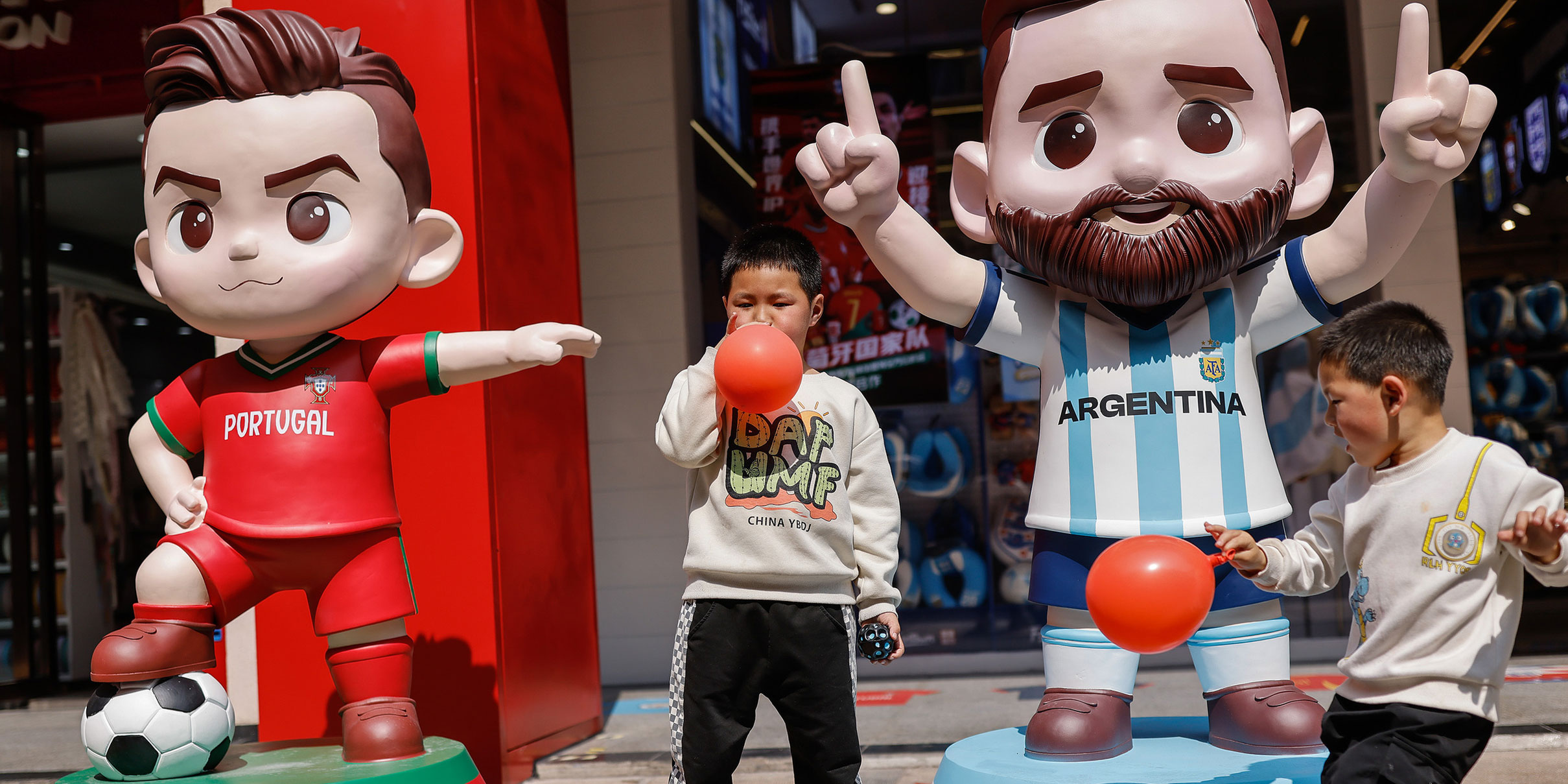
(Header image: Two boys play around the sculptures of Lionel Messi and Cristiano Ronaldo in Yiwu, Zhejiang province, April 19, 2026. Wang He/Getty Images via VCG)